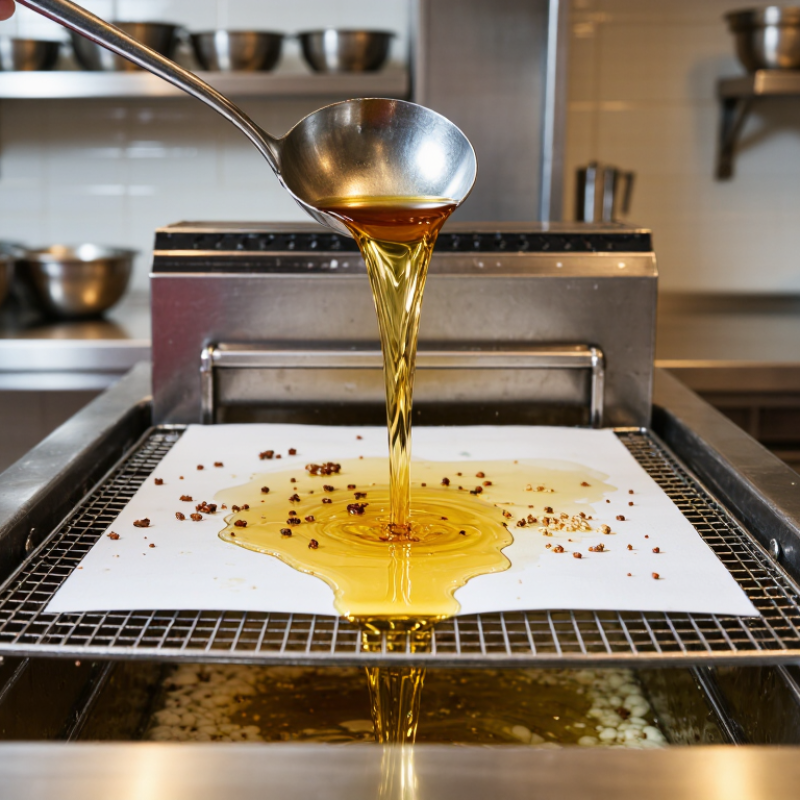
| Filter Paper Material | Cellulose fiber; sometimes combined with food-contact-safe wet-strength or retention additives | The fiber network captures suspended food particles through depth filtration, surface interception, and adsorption. | Use paper specifically manufactured for edible-oil filtration and verify that it is suitable for the intended temperature and food-contact application. |
| Basis Weight | Approximately 40–120 g/m² for many disposable filtration papers | Higher basis weight generally provides a deeper fiber structure and greater dirt-holding capacity, but may reduce flow rate. | Select a heavier grade when the oil contains substantial crumbs or carbonized particles; use a lighter grade when faster throughput is the priority. |
| Paper Thickness | Approximately 0.15–0.60 mm, depending on construction | Greater thickness can improve particle-loading capacity and extend service life before clogging. | Thickness should be evaluated together with basis weight, permeability, and wet strength rather than used as a standalone quality indicator. |
| Nominal Particle Retention | Common grades are often designed for roughly 5–50 µm particles | A finer structure removes smaller suspended particles more effectively, while a coarser structure usually provides higher flow and longer operating time. | Choose the retention level according to the target cleanliness of the oil and the particle load. Nominal retention is not the same as absolute retention. |
| Oil Temperature | Many commercial frying oils are filtered around 60–90°C; follow the equipment and paper limits | Higher temperature lowers oil viscosity and normally increases flow, but excessive heat can weaken the paper or accelerate oil oxidation. | Filter after the oil has cooled to a safe operating range. Do not pour oil at active frying temperature onto paper unless the system is specifically rated for it. |
| Oil Viscosity | Typically decreases substantially as temperature rises; varies by oil type and degradation level | High-viscosity oil creates more resistance within the paper and reduces filtration throughput. | Maintain a consistent filtration temperature and avoid comparing flow rates measured at different temperatures or with different oil conditions. |
| Differential Pressure | Should remain within the filter holder or equipment specification | Pressure drives oil through the fiber network, but excessive pressure can deform the paper, cause bypass, or release trapped particles. | Replace or clean the filter when pressure rises noticeably, flow slows sharply, or the paper becomes heavily loaded with solids. |
| Oil Flow Rate | Depends on filter area, viscosity, temperature, and paper permeability; generally decreases during use | A higher flow rate improves productivity but can reduce contact time and may allow fine particles to pass through if the paper is overloaded. | Use the manufacturer’s equipment rating as the operating limit and avoid forcing oil through a clogged sheet with excessive pumping pressure. |
| Solids Loading | Varies with food type, frying time, breading, batter, and cleaning frequency | Accumulated crumbs form a filter cake that may initially improve fine-particle capture but eventually restricts flow and increases pressure. | Remove large crumbs before filtration when possible and change the paper before the accumulated cake causes bypass or unacceptable throughput loss. |
| Moisture Content | Should be minimized before filtration | Water in hot oil can cause dangerous splattering, accelerate oil degradation, and reduce the stability of cellulose-based paper. | Keep wet food residue and wash water away from the filtration process. Ensure the filter, housing, and oil-contact surfaces are dry. |
| Wet Strength | Must be sufficient for the intended oil temperature, residence time, and pressure | Adequate wet strength prevents tearing, collapse, and fiber release while the paper is saturated with oil. | Inspect the sheet before use and stop operation if tearing, edge separation, or visible paper migration occurs. |
| Filter Area | Larger area lowers the loading per unit area at the same batch volume | Increasing filter area generally raises total capacity and reduces the pressure drop needed to maintain a given flow rate. | Size the filter according to oil volume, expected solids load, target filtration time, and the available holder or machine dimensions. |
| Oil Condition | Affected by oxidation, polymerization, free fatty acids, and thermal history | Filtration removes suspended solids but does not remove all dissolved degradation products or reverse chemical oxidation. | Use filtration as part of an oil-management program that also includes temperature control, cooking-time management, and regular oil-quality checks. |
| Filter Replacement Point | Determined by pressure rise, reduced flow, visible loading, or a defined batch limit | Continuing to use an overloaded filter increases resistance and may reduce filtration consistency or cause particle bypass. | Establish a replacement rule based on operating data rather than waiting for complete blockage or paper failure. |